

Group Counseling and Group Work: Group Proposal

Updated: Nov 18, 2025




Addiction Group Counseling Proposal
Alexandra Arpey
COUN 634 – Group Counseling
Dr. Jennifer Bays
November 16, 2025
Introduction
Addiction is often thought of as a cyclical and persistent disease that affects not only the individual but also families, communities, and workplaces. Recovery extends far beyond abstaining from drugs and alcohol; substance abuse recovery requires developing coping skills, altering thought processes, and creating peer support networks. Group counseling has consistently been shown to be an effective modality because it combines professional support with peer accountability and shared experience (Yalom & Leszcz, 2020). This proposal presents a structured group counseling proposal for adults in early substance abuse recovery. This is considered to be a vulnerable time with a high potential for relapse. The group will focus on relapse-prevention strategies, be psychoeducational, and foster active and positive peer support, all in an effort to support long-term recovery.
Overview
The cohort is designed to meet 10 times, once each week, over a period of 90 minutes each time. The group can be described as short-term and remedial, focused on addressing the needs of persons who have experienced harm through substance use and need stabilization and relapse prevention support. Group objectives are (1) coping strategies for cravings and stress, (2) relapse-prevention skills through understanding triggers and sober routines, (3) accountability, and (4) reducing isolation and building peer relations. Group counseling was selected over individual counseling for various reasons. Group work engages participants in sharing experience, normalizing their experience, and practicing coping skills in the moment. Research indicates that hearing about others’ recovery moments can reduce shame and stigma, and also increase accountability and resilience (Corey, Corey, & Corey, 2021). From a practical perspective, group counseling as an intervention is more efficient than individual counseling; participants are exposed to diverse experiences and alternative perspectives, adding significance to the therapeutic experience. Evaluation of group effectiveness will be conducted through the session leader’s observations, participants’ reflections at the end of the group, and the administration of formal pre- and post-group surveys to measure coping confidence, relapse-prevention knowledge, and recovery self-efficacy.
Membership
The population targeted for this group will be adults aged 18 and older who have been sober for less than six months, as this is a time period that is recognized to have increased risk for relapse. Participation in this group will be voluntary, and participants will be recruited from community-based treatment centers, sober living programs, and referrals from outpatient counselors. Before ensuring readiness, regarding the group’s appropriateness, and screening for the need for a higher level of care, prospective participants will complete a brief intake interview to discuss personal goals. The number of participants in the group will also be limited to 8–10 participants to promote intimacy within the group and to allow for diverse views and opinions.
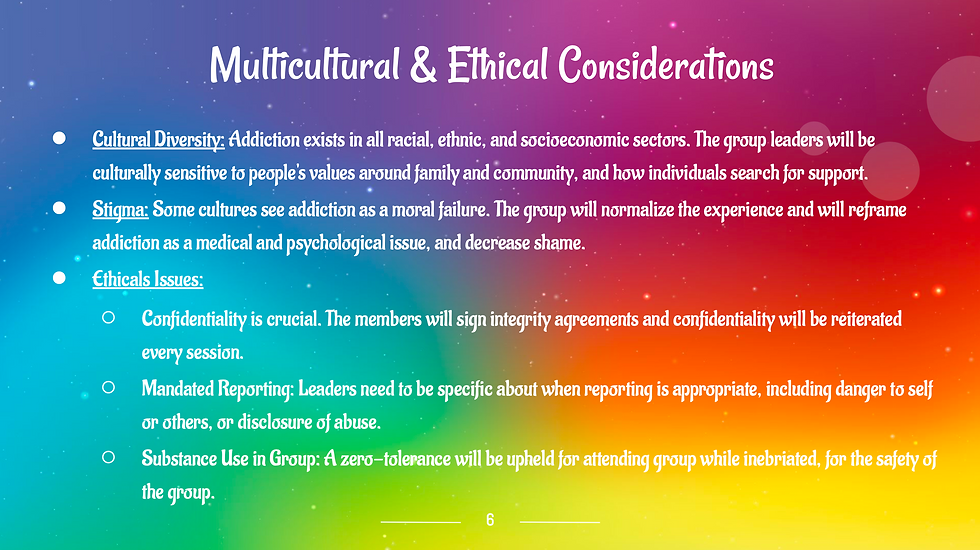
The purpose of this proposal will contain multicultural considerations, as addiction affects people across racial, ethnic, and socioeconomic groups. The group leaders will be mindful of cultural values related to the notions of family, community, and healing, as these concepts are relevant to the recovery journeys of the participants. In keeping with the multicultural aspects of the proposal, the leaders will be supportive of the fact that some cultures perceive their substance use as a moral weakness. The leaders will therefore frame substance use as a medical and psychological problem rather than a moral weakness, to avoid stigmatization and provide greater motivation for members to receive treatment. The ethical considerations include the implicit agreement about confidentiality of the content of all membership, as well as setting limits on harm to self or others, mandated reporting (leaving leaders with limited options) for child abuse (American Counseling Association [ACA], 2014). To ensure the safety of the membership, a zero tolerance for being present in the group under the influence of a substance will also be part of compliance.
Leadership
The group will be facilitated by a Licensed Professional Counselor Associate (LPC-A) with clinical supervision, or a Licensed Chemical Dependency Counselor (LCDC) with training in group therapy. The leader(s) will provide structure, maintain ethical practices and environmental safety, and model coping skills, guiding group members through skill-building exercises with the members’ best interests in mind. The group will be based on Cognitive Behavioral Therapy (CBT) and Motivational Interviewing (MI). Through the use of CBT, group members will address and discuss unhealthy thought patterns, relapse-prevention planning, and role-playing healthier behaviors. MI will provide group members with motivation to maintain their commitment to change and combat ambivalence (Corey et al., 2021; Yalom & Leszcz, 2020).
At the last session, follow-up procedures will be conducted to help members assess their progress and adjust their relapse-prevention plan. Optional alumni meetings will be provided for participants as a follow-up resource to support continued accountability. Members may also be referred for individualized counseling, peer-to-peer recovery such as Alcoholics Anonymous, SMART Recovery, or a higher level of care if indicated by their presentation in group. The leaders may offer short, individual check-ins with members. Still, the focus for addressing member concerns will be primarily set within a group context that instills recommendation and accountability on every participant’s behalf.
Session Format
Participants will sign informed consent forms addressing confidentiality, voluntary participation, attendance commitments, and the limitations of mandated reporting. The group’s ground rules are: respect yourself and others, maintain confidentiality, observe sobriety at meetings, and attend all meetings. The format of each group session will include: (1) member check-ins; (2) psychoeducation and skill building (e.g., craving management, identifying triggers during relapse); (3) group discussion and process; and (4) self-reflection and goal setting. The group will progress through the stages of forming, storming, norming, performing, and adjourning, while leaders will change roles to adapt to the group’s state (Corey et al., 2021).
Conclusion
The group will deliver a structured, research-supported approach geared towards assisting adults who have recently embarked on their journey of recovery from substance use disorder (SUD). This program combines Cognitive Behavioral Therapy (CBT) and Motivational Interviewing (MI), delivered in a group setting with a focus on cultural competence. It aims to equip group members with critical relapse-prevention skills, accountability, and peer support. The form of the group is aimed not only to reduce stigma but also to facilitate interpersonal growth. Group members will be able to see and feel that they aren’t alone, which can help reduce feelings of shame and bolster motivation for continued recovery. The group also provides group members with an opportunity to practice communication, coping, and problem-solving skills in a real-world context that mimics ongoing recovery, which is especially important during phases of abstinence in recovery. This program will facilitate far more than just relapse prevention; it is designed to build self-efficacy, harness resilience, and empower the establishment of a healthy foundation for continuing recovery. Participants will leave with specific techniques, a revised relapse-prevention plan, and continuing peer support to be equipped to forge ahead and maintain their sobriety and healthy connections into the future.
References
American Counseling Association. (2014). ACA code of ethics.
Corey, M. S., Corey, G., & Corey, C. (2021). Groups: Process and practice (10th ed.). Cengage.
National Association of Addiction Treatment Providers. (n.d.). Addiction Treatment Statistics. https://www.naatp.org/addiction-treatment-statistics
New Method Wellness. (n.d.). Benefits of Group Therapy for Substance Abuse.
Olympic Behavioral Health. (2024, July 26). Group Therapy for Addiction: Definition, Usages,
Priory Group. (n.d.). Group Therapy. Priory. https://www.priorygroup.com/our-services/group-
therapy
Valley Spring Recovery Center. (2025, June 15). Addiction in the Workplace: Statistics and
Yalom, I. D., & Leszcz, M. (2020). The Theory and Practice of Group Psychotherapy (6th ed.).
Basic Books.


Comments